April 12, 2006
EYE OF THE BEHOLDER
by Victor Davis Hanson
The American Enterprise Online
War-torn Iraq has about 26 million residents, a peaceful California perhaps now 35 million. The former is a violent and impoverished landscape, the latter said to be paradise on Earth. But how you envision either place to some degree depends on the eye of the beholder and is predicated on what the daily media appear to make of each.
As a fifth-generation Californian, I deeply love this state, but still imagine what the reaction would be if the world awoke each morning to be told that once again there were six more murders, 27 rapes, 38 arsons, 180 robberies, and 360 instances of assault in California — yesterday, today, tomorrow, and every day. I wonder if the headlines would scream about “Nearly 200 poor Californians butchered again this month!”
How about a monthly media dose of “600 women raped in February alone!” Or try, “Over 600 violent robberies and assaults in March, with no end in sight!” Those do not even make up all of the state’s yearly 200,000 violent acts that law enforcement knows about.
Iraq’s judicial system seems a mess. On the eve of the war, Saddam let out 100,000 inmates from his vast prison archipelago. He himself still sits in the dock months after his trial began. But imagine an Iraq with a penal system like California’s with 170,000 criminals — an inmate population larger than those of Germany, France, the Netherlands, and Singapore combined.
Just to house such a shadow population costs our state nearly $7 billion a year — or about the same price of keeping 40,000 Army personnel per year in Iraq. What would be the image of our Golden State if we were reminded each morning, “Another $20 million spent today on housing our criminals”?
Some of California’s most recent prison scandals would be easy to sensationalize: “Guards watch as inmates are raped!” Or “Correction officer accused of having sex with underaged detainee!” And apropos of Saddam’s sluggish trial, remember that our home state multiple murderer, Tookie Williams, was finally executed in December 2005 — 26 years after he was originally sentenced.
Much is made of the inability to patrol Iraq’s borders with Iran, Jordan, Kuwait, Saudi Arabia, Syria, and Turkey. But California has only a single border with a foreign nation, not six. Yet over 3 million foreigners who snuck in illegally now live in our state. Worse, there are about 15,000 convicted alien felons incarcerated in our penal system, costing about $500 million a year. Imagine the potential tabloid headlines: “Illegal aliens in state comprise population larger than San Francisco!” or “Drugs, criminals, and smugglers given free pass into California!”
Every year, over 4,000 Californians die in car crashes — nearly twice the number of Americans lost so far in three years of combat operations in Iraq. In some sense, then, our badly maintained roads, and often poorly trained and sometimes intoxicated drivers, are even more lethal than Improvised Explosive Devices. Perhaps tomorrow’s headline might scream out at us: “300 Californians to perish this month on state highways! Hundreds more will be maimed and crippled!”
In 2001, California had 32 days of power outages, despite paying nearly the highest rates for electricity in the United States. Before complaining about the smoke in Baghdad rising from private generators, think back to the run on generators in California when they were contemplated as a future part of every household’s line of defense.
We’re told that Iraq’s finances are a mess. Yet until recently, so were California’s. Two years ago, Governor Schwarzenegger inherited a $38 billion annual budget shortfall. That could have made for strong morning newscast teasers: “Another $100 million borrowed today — $3 billion more in red ink to pile up by month’s end!”
So is California comparable to Iraq? Hardly. Yet it could easily be sketched by a reporter intent on doing so as a bank rupt, crime-ridden den with murderous highways, tens of thousands of inmates, with wide-open borders.
I myself recently returned home to California, without incident, from a visit to Iraq’s notorious Sunni Triangle. While I was gone, a drug-addicted criminal with a long list of convictions broke into our kitchen at 4 a.m., was surprised by my wife and daughter, and fled with our credit cards, cash, keys, and cell phones.
Sometimes I wonder who really was safer that week.
©2006 Victor Davis Hanson
Some additional perspective:
The average number of murders in the United States each day is 53.
Compare that to the constant river of bad news reported about Iraq each day.
It makes us about equal.
Except that we are about 11.5 times bigger.
Yes, we are safer here, statistically, but things are not really as bad in the war zone as the news wonks would have us believe.
Tuesday, October 31, 2006


Monday, October 30, 2006
My Burning Bush
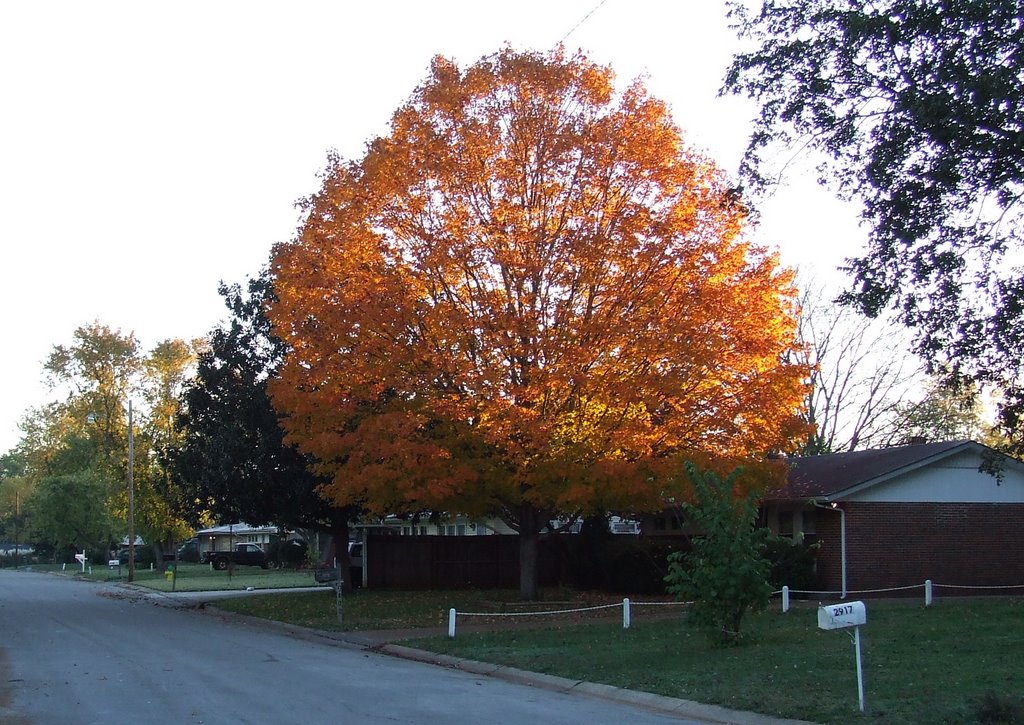
I snapped this yesterday AM after returning from my morning walk.
My Maple tree likes to show off for a few days each Autumn.
The price I pay for this beauty is a couple of hours of raking of the leaves after they all jump overboard.
I do not like Fall or Winter.
The cold weather and bare plantage weigh on my moods.
Wednesday, October 25, 2006
World Champion Pancake
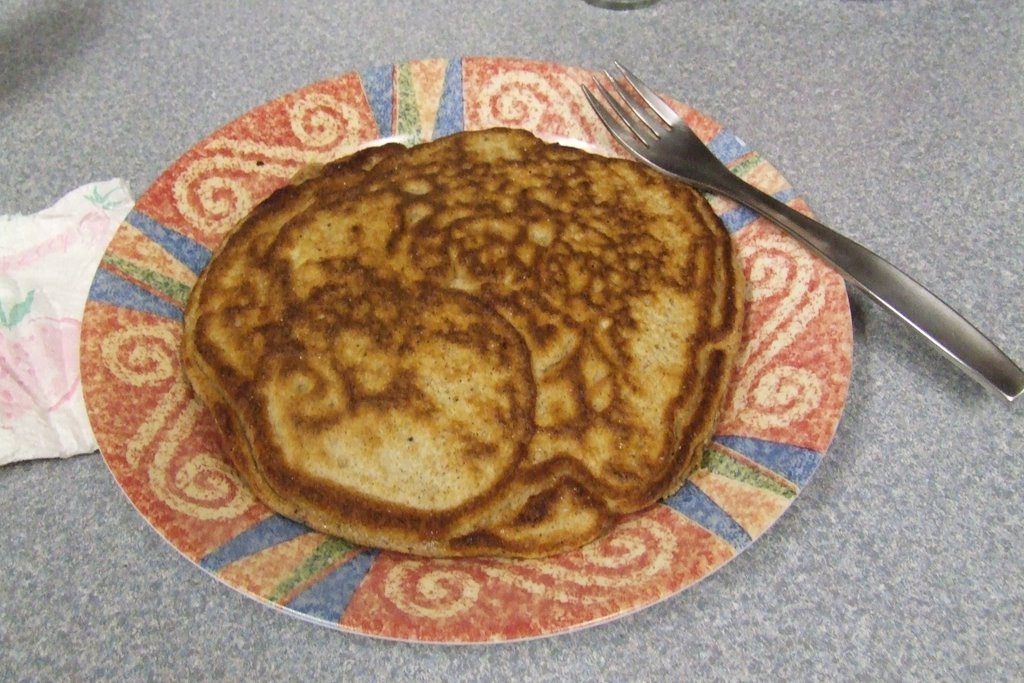
Presented for your edification and envy is a picture of the pancake that I usually make for myself each Sunday morning before church.
As you can see, it is large enough that I only need one.
It could be described as a whole wheat, buttermilk, spice pancake, which includes Nutmeg, Cinnimon, and cloves.
It contains no sugar or oil (the pan is oiled).
It is very tasty.
Tuesday, October 24, 2006
Fonetik Speling 2
FONETIK ALFABET
So heer is a reekap of the plan.
A - a, after, trap, matter.
aa, able (= aabel),
ah, auto, august (=ahgust),
B - no chaanjes
C - Eeooz S or K for most uses.
Ther is no substitoot for the “ch” sound, as in “church”.
D - No chaanjez
E - ee, free, bee
e, elevator, better.
The sound of “-er” wil bee spelled “ur”, so “meter” = “meetur”.
F - No chaanjez
G - Keep only hard “g” sound, as in “go”, garage = garaj
see “J”,
The “gh” as in “enough” beekums “f”, as “enuf”
usage = eeoosaj
H - no chaanjez
I - Keep only short “I” sound, as in “it”,
Long sound as in “kite” beekums kiit.
J - Beekums soft “G” sound. So “German” beekumz “Jerman”.
K - Beekums the hard sound for “C”.
L - No chaanjez.
M - No chaanjez.
N - No chaanjez.
O - Long sound reeplaasez the long “u”, so “rule” beekumz “rool”,
“Toll” = “toal”,
“zone” = “zon”.
“lock” = “lok”.
P - “Ph” sound for “f” is eeliminaated
Silent first letter as in “psychology” wil beekum “sykalojee”.
No chaanj to standard “P” sound as “pretty”, “pumpkin”, “puddel”.
Q - “Qu” kombinashon wil bee reeplaased with “kw”, so “quick” = “kwik”
R - No chaanj
S - No substitoot for “sh” sound, see “C”
Long “s” as in “use” would beekum “yooz”.
T - no chaanjez.
U - The long “u” as in “use” beekumz “yoos”, or “yooz”.
The short “u” sound is reetained, so, “summer” = “sumer”
V - No chaanjez.
W - Feeoo chaanjez.
“New” wil beekum “noo”.
X - Sum reeplaasments, as in “xray” = “eksraa”, xerox = ziroks or zeeroks.
Y - The long “y” sound is reeplaased by “ii”.
So “type” beekumz “tiip”, “cycle” beekumz “siikel”.
The long ending sound of “yummy” beekumz “yumee”.
Short “y” sound wil bee asoomed by “I”, so “typical” wil beekum “tipikal.”
Werds that start with “y” reelee hav the saond of “eeoo” liik, “you”.
This leevs veree littel for “y” too doo.
Z - Reeplaases “s” in sum werdz.
JENERAL RULZ
Long vowul saoond wil bee a dubul leter, as in “aa”, “ee”, ”ii”, “uu”.
Short vowel saoond wil bee singel leter.
Soft vowel saond wil bee indikated bii too vowels, as in “sound” – “saoond”.
No dubul konsonants.
No “e” on the end of a werd – eksept “the”.
PROBLEMS
Ther ar sum problemz with this sistem.
The leter “y” is won.
On the end of a werd it has the saond of a long “ee”.
Liik “many”, “city”, “pretty”, etc.
Under mii rools the long saond of a vowel wil bee indikated bii the dubel leter “ee”.
So, “many” beekumz “menee”, “city” beekumz “sitee”, and “pretty” beekumz “pritee”.
But mii sens of ekonomee haats to ad leters too werds, wich maaks them longer.
I kud yooz “y” insted of “ii” in all werdz but I haat to braak mii rool.
And if I did, it wud giv “y” too diferent saoonds – “ee” and “ii” – not konsistant.
The long “oo” saond and the long “uu” saoond ar the saam.
So wich won doo wee yooz?
Doo wee riit “doo” or “duu”?
Is it “soo” or “suu”?
Or “fool” or “fuul”.
See?
Mii plan now is too yooz the vowel that the kurrent speling yoozes – most of the tiim.
Taak the werd “pocket”.
Under mii rools it wud bee speled “pahket”.
“Look” shud bee pronaoonsed “luuk”, but akording too mii noo rools. (dubel vowel is the long sound), the speling shud be “luak” (Not long saoond liik “luke” or short saoond liik “luck”)
In the new way, “luke” wud bee speled “look” and “luck” wud bee speled “luak”.
This stiil gives mii spel cheker fits, but wons yoo get yoosd too riiting liik this, it is hard too go bak too the current method.
The end.
Monday, October 23, 2006
Noo Fonetik Speling Rools
This is an eksperiment in developing a fonetik alfabet and ajusting speling rools akordeenlee.
It is generally known that the English language is a collage of many languages. This collection of languages reflects the migration of people and ideas to Europe and the United States from nations all over the world.
Many words that have been adopted into our everyday language have come from other languages.
This is not unusual, it happens to virtually every language on earth.
But it does make English one of the more difficult languages to learn because the spelling rules are so varied and have so many exceptions.
And spelling is where I have – and have always had – a problem.
There are two ways to simplify my problem.
One way is for me to just learn to spell better by more study.
The other is the change the alphabet and rules of spelling for the rest of the world so that spelling words is more consistent and intuitive for me.
So in an effort to simplify my spelling problems, I propose the following changes to the English alfabet and speling ruls.
The main problem is with the vowels – a, e, i, o, u, and sometimes y.
Most of them have two sounds (uses) in words, and a few have three.
In some words the sound/pronunciation of two different vowels are the same.
In some words the sound/pronunciation of the same vowel is different.
You cannot tell how to pronounce each vowel by just looking at the word. There are a few problems with consonants, too.
But these are easily fixed.
This section was written in the current/old way to break you in gently.
Things wil change after this.
SUM EKZAMPELS OF ENGLISH SPELING INKONSISTENSEEZ
Heer ar sum eksampels of the mes our languaj is in.
“tub” is pronounsed ”tub” – short “u” saoond.
“Flood” is pronounsed “flud” - The same short “u” saoond.
Eksept there is no “u” in it.
Go figuer.
“Tube” is pronounsed “toob”.
The “e” is silent but changes the way we pronouns the “u”.
Take away the “l” in “flood” and you have “food”.
“Food” is pronounsed “fuud” - the long “u”: sound.
The same letters as “flood”, minus the “l”, but the dubel “o” bekomes the long “u” sound.
Go figeur sum mor.
Like “tool”, “school” and “fool”.
And “rule”.
Oops!
See?
But “Foot” is pronounsed “fut”. The short “u” sound again.
See wat I meen?
Luk at “on”.
Then luk at “one”.
Wee ad an “e” on the end and maak the “o” a soft “a” sound and ad an invisabel “w” on the front.
So “one” sounds the saam as “won”.
And ther ar minee mor, liik -
Seen vs scene, but not “sceen” or “ceen”.
Steel vs steal, but not “steeal”.
Or, “to” vs “too” vs “two”.
We all luak at thees werds and understand that the different forms of thees saoond-aliik werds meen somthing different. But the different sets of letters that saond the saam ar veree konfeoozing.
So, let’s fiks the speling ruls to maak them mor simpul and konsistant.
First – no werd shud end with an “e”.
The eksepshon to this is “the”.
How nice.
Wee start off with an eksepshon.
THE VOWELS.
A
The letter “a” has three sounds.
The long sound as in “able”.
A short sound as in “after”.
And a soft sound as in “auto”.
I propose the following chaanjes:
The long “a” sound wil be designated by the dubel letter.
This rul wil bee troo for all vowels.
Thus, “able” wil beekum “aabel”.
The short “a” sound wil bee the single letter.
This wil involve no chaanjes for many werds.
The soft “a” sound wil beekum a kombinaashon of the letter “a” with either “u” or “h”, as in “august”.
This kombinashon wil also take over the soft “o” sound. (see “O”)
E
The letter “e” has two sounds.
The long saoond as in “be”.
And the short sound as in “better”.
The long “e” sound wil bee designated by the dubel letter.
So “be” wil beekum “bee”.
“Team” wil beekum “teem”.
Most werds with the short “e” sound wil not chanj.
I
The letter “I” has two sounds.
The long sound, as in “time”.
And the short sound, as in “it”.
The long “I” sound wil bee designated by the dubel letter as “ii”, in keeping with my rool.
The dubel “I” sound will reeplaas the long “y” sound.
The long “y” sound wil bee reetiired.
Thus, “try” wil beekum “trii”.
“Tie” wil beekum “tii”
The short “I” sound and spelling wil not bee chaanjed.
O
The vowel “o” has three sounds.
The long sound as in “moon”
The short “o” sound as in “toe”
And the soft sound as in “lock”.
The long “o” wil bee designated by the dubel letter, as in “fool”, and “loon”.
Few chanjes heer.
The short “o” sound wil bee designated with the singel letter.
Thus, “toe” wil bee written “to”.
This maa taak som geting used too.
The soft “o” sound as in “lock” wil bee designated by the single letter “a” plus the letter ”h” or “u”.
Thus “lock” wil bee written “lahk”,
“Clock” – “klahk”.
U
The vowel “u” has two sounds.
The long sound, as in “tune”.
And the short sound as in “summer”.
Sintz the long “u” sound is the saam and the long “o” sound (“tune” vs “soon” vs “dune” vs “room”), the long “u” sound wil bee taken over bii the dubel “o”.
So “tune” wil beekum “toon”. (and “dune” > “doon”)
Konsistent with the new dubel leter rool.
“Use” would beekum “eeooz” or “eeoos”, depending on the eeoosaj.
The short “u” sound wil bee designaated bii the singel letter as is kurentlee dun.
Y
The sometimes vowel “y” has four sounds.
The long sound as in “type”.
The short sound as in “typical”.
The ending long “ee” sound as in “happy”.
And the leading “ee” sound as in “yes”.
This letter kud bee eeliminaated bekaus all of its sounds are dooplikats of egzisting leters.
The long sound is kovered bii the dubel “ii” sound.
Thus, “type” beekums “tiip”.
The short sound as in “typical” beekums “tipikal”.
And the leading and ending sounds are aktooalee the saam as the long “ee” sound.
Thus, “happy” beekums “hapee”, and “yes” beekums “eeas”
THE KONSONANTS
B, D, F, G, H, K, L, M, N, P, R, S, T, V, W, X, Z - few chanjez needed.
C
Eeooz “s” or “k” for most eeooses, there is no substitoot for “ch” as in “church”.
Thus, “can” beekums “kan”, and “center” beekums “senter”.
G
Wee keep only the hard “g” saoond, as in “go”.
The soft “g” saoond is the saam as “j”.
Thus, “garage” beekums “garaj”, “garbage” beekums “garbaj”.
J
Is the saam as the soft “g” sound, as in “jump”.
It wil reeplaas the soft “g” sound in al werds that hav it.
K
Beekums the hard sound for “C”.
Thus, “becomes” beekums “beekums”, “car” beekums “kar”, “cake” beekums “kaak”.
P
The “ph” kombinaashun for the saoond “f” is eliminated and replaasd with “f”.
Thus, “phantom” beekums “fantom”.
Silent first letter as in “psychology” wil beekum “sykalogee”.
No chanj to standard “P” sound, as in “pretty”, “pumpkin”, “puddel”.
Q
“Qu” kombinaashun is reeplaased with “kw”, so “quick” beekums “kwik”.
This letter kan bee eeliminated.
S
No substituut for “sh” sound.
This beekums the noo vershun of the soft “c” sound.
Thus, “cirrus” beekums “sirus”. (see “C”)
Long “s” as in “use” would beekum “yooz”.
X
Some reeplaasments with “ek”, so “xray” beekums “eksraa”.
“Xerox” beekums “Ziroks” or “Zeeroks”.
Z
Reeplaass “s” in some werds. So, “was” beekums “waz”.
LETTER KOMBINAASHUNS
The “ou” in many werds as “enough”, wil beekum “eenuf”.
The “qu” and “tion” in “equation”, wil beekum “eekwaazhun”.
The “sion” as in “erosion”, wil beekum “eeroshun”.
The “wh” kombinaashun as in “which” wil beekum “wich”.
The “ou” kombinaashum as in “should” wil beekum “shud”
“Could” wil beekum “kud”.
And “would” wil beekum “wud”.
Mor too kum...
Wednesday, October 18, 2006
My Love Affair With Running - Part 4
WHY I STOPPED
I was completing a 3 mile run in my neighborhood one Wednesday afternoon in early March 2006 when I was struck by a shocking thought. My run had been another difficult effort. It was becoming increasingly difficult to hold my running pace. My lung capacity and the strength in my legs seemed to be contracting. Many days, I would only be into mile one of my session and I found myself breathing harder than I wanted to and wishing to stop and walk. I would have to fight fatigue and negative thoughts and argue with myself almost every session. The Wednesday afternoon runs after work were becoming noticeably more difficult. My job seemed to be taking more and more out of me, leaving less and less to give to my runs. (In fact, my job was no harder than it had ever been, my strength seemed to be diminishing.) Seldom did I feel the joy and mental release of my previous sessions. Now I seemed to spend all my mental effort wondering if I could finish the current session.
Discomfort was not new to me. There were always little twinges of pain and discomfort that presented themselves during many of my runs. Some sharp, like a well-placed ice pick next to a knee-cap or hip joint. Others were dull aches that hid, submerged in hip, calf or thigh. Most of them went away after just a few dozen steps. A few required more aggressive resistance for a tenth of a mile or more. Fewer still joined me during a session and stayed to the finish – and beyond. Still others, made their presence known the day after a run to remind me of the level of effort I had given to the cause. I had gotten used to all of them. They were part of the price I paid for the sublime pleasure and strength running gave to me. And I paid it gladly.
But lately, new aches and pains began to join me on my practice sessions. Strange new sharp pains in the top of my left foot one day made me wonder if I was going to have to stop. It felt like two of the bones in my foot were trying to occupy the same place under my skin. And there was that ice pick in there, too. The pain went away after a few hundred feet of limping strides. Another time my right knee almost collapsed under my weight and for several steps, I thought I would have to stop to keep from falling down in the street. For a few moments, I thought I was having a stroke. This passed, too, only to return a few days later. It was un-nerving. This had happened a couple of times before on the Cotton Row course, but never so persistently. I was beginning to feel constantly tired – a sure sign of overtraining. But I was only running six miles a week, in two sessions. That is a very easy program. I did not like what I was feeling. And the trend was not good.
I shocked myself as I approached my house that Wednesday afternoon and the thought surfaced in my mind, I may have to stop running. I could not believe that I entertained such heresy. I loved to run. I wanted to keep running into my 80’s. I had a reputation among those who knew me as a runner. How could I explain this to them? My ego was at stake. Suddenly, I was seriously considering stopping. I could hardly believe I was thinking such thoughts, but my growing discomfort made the idea easier to rationalize.
I had been lifting weights for five years before I started running. That activity had been productive before. If I were to go back to a more vigorous weight lifting program perhaps it could be as productive again. I ran that following Sunday morning knowing it could be my last time. I put the thought out of my mind and tried to enjoy the run. The session was reasonably enjoyable with a pretty strong finish, but did not have the magic of my past sessions on the Cotton Row course. The thought kept dogging me, is this the last time? I did not want to stop, but running was no longer fun like it had been. I finished my run that morning still wondering if I would ever run again. I did not want to think about it.
The next Wednesday, I consciously came home from work, knowing it was my “running day”. I had thought about it all week and during that day, as I usually did. In days past, I looked forward to it. Today, I was dreading it. At home, I thought about going out as I had done almost every Wednesday afternoon for the last five years. But something had changed in me. The joy of running had left. It was becoming too difficult to be fun any more. Just the thought of not running depressed me. Did I really want to do this? No. I wanted to run. But it was becoming so difficult that it was no longer enjoyable. My mind rebelled at the prospect of not having its twice-weekly endorphin fix. But the decision had been made. I was going to stop running and today was the day.
In reality, difficulty in running was not the reason I had to stop. It was my job. It was/is a somewhat demanding position, physically. I am the oldest person doing this kind of work in the company. If I had had a desk job pressing computer buttons all day, I would probably still be running. But such was not my lot. Basically, my job took more out of me than I could recover from. And the load of work, running, and weight lifting combined to be too much for my body to take. Even though I was constantly cutting back on both my running and my weight lifting sessions, it was sill not enough to offset the effort required by my job.
POSTSCRIPT
I looked at my running bag with sadness. It had accompanied me to every non-neighborhood practice session and every race for the last five years. Every time I ran the Cotton Row course, it had waited patiently for my return in the car. It still held my Boy Scout assortment of items that might be needed after a race in a distant location. Things like an extra pair of socks, underwear, a towel, sunscreen, rubbing alcohol, and a small plastic container of safety pins to attach racing numbers to my singlet. Now it sat in its usual spot on the floor looking forlorn, deflated. It seemed to beckon me like a faithful dog wanting to go for a walk. If my bag had a tail, it would be wagging. It had become just another reminder of my loss.
In the closet in my gym room I saw the array of special clothes that had become my companions to keep me comfortable during races and training sessions for the last five years. Nylon running shorts, short sleeve Cool-Max tops, nylon singlets, terry-cloth sweat bands for summer, Cool-max long-sleeve tops for winter running, fleece ear warmers, nylon pants with zippered cuffs so they can be removed over running shoes, and Cool-max socks. I looked at all of them with sadness. I felt like I had abandoned old trusted friends. And in a way, I had. I was a traitor.
My running shoes sat in their usual place by the door, looking eager to go again, as always. But I had nothing to give them. My body was spent; broken. My faithful soul mates were to be retired with little warning, fanfare or recognition for their steadfast support. I wondered many times in those first days of retirement, was I sure I wanted to do this?
The answer was no. I do not want to do this. I loved to run. I still love to run. Part of me is ready even now to climb into my running gear and hit the street. To feel the wind in my face, on my arms and legs. To hear the pat – pat – pat of my feet on the pavement, the quiet roar of the wind in my ears, and to feel the blood charging through my veins. To feel the sweat run off of me as a symbol for the physical and emotional cleansing running provided. To feel my rapid breathing, just short of discomfort. I never felt so alive as when I was running. That part of me still wants to run. I still encourage anyone who can (and more can than think they can) to begin a regular running program.
I will always want to run. And I will always love running. But the reality is I cannot anymore. My mind is still ready; still wanting to go. But my body, always limited by deficient genetics and now by advancing age, had signaled its surrender. Or maybe it’s rebellion. It no longer matters what my mind wants. My body does not like to run anymore. And it was increasingly signaling its refusal to participate.
It was disappointing to feel how good it felt to not run that first week of retirement. My body really was tired. I was overtrained. Or overworked. But I felt like a traitor. I hated myself. And I missed the post-session endorphin buzz. That made my depression feel even stronger.
It has been suggested by some that I just run less; like a mile or so, to accommodate my decreasing endurance, and I have considered just such a possibility. But a mile run would only last about nine or ten minutes for me. A two mile run, less than twenty. Somehow running less than three miles seems pointless. The cardiovascular and fat-burning benefits of such a session would be almost nil. It would be an endeavor hardly worth getting dressed for. A run duration of less than twenty-five or thirty minutes seems not worth the preparation. It would be a distance reminiscent of my pre-racing days. When I first started running, a mile was a big deal; and it still is to my non-runner friends. Now it is merely a convenient marker on a larger measure of distance and enjoyment. No, cutting back to less than three miles is not really useful.
And I could walk, as some have suggested. Walking is a worthy endeavor and many people do it. I have considered this also. I may yet do some form of walking program. But for now, I cannot do it. Going out and covering the same path that I used to run on would be painful. And if I were to walk those same roads, I am sure I would hear my friend whimpering like a faithful dog, and asking, “why are you doing that? We used to have such fun together.” And it would be true. We had a wonderful time together.
Running was like a friend. A dear, faithful friend. It taught me some surprising things about myself, both physically and mentally. We had some wonderful times together. It seldom let me down. Next to knowing God, running was one of the most delightful experiences of my life. I hate to let it go. I will miss running for the rest of my life.
Update October 2006
I have started walking a two-mile course around my neighborhood. I do this almost every day. The circuit takes about 35 minutes. I do not get the same buzz I used to receive from my runs but it is invigorating. And I am tempted nearly every time I go out to run. Some day perhaps I will.
SN
Monday, October 16, 2006
Bishop Appreciation Poem
This past Sunday was Appreciation Day for our Pastor and his wife.
In preparation for this event, the sister organizing the festivities asked me to present a poem.
I was a bit taken aback by the task, but agreed to come up with "something."
I had no idea what that "something" would be.
I did a quick search of the internet to see what was out there to serve as the whole presentation or a spark for an original compostion.
I found only one poem that even came close to usable in my specific application.
One stanza of the poem made reference to a scripture which provide a spark for a method of constructing an original poem.
Several scriptures came to mind and I jotted them down.
Then I began building stanzas around the verses.
The next thing I knew, I had a poem.
God just used my computer and helped the words flow.
Here it tiz....
Watchman, watchman, what of the night?
The scriptures ask of thee
If dangers creep around in darkness
Who will stand to see?
Who will sound the alarm
When evil sneaks around the camp?
We need a watchman who will use
The word of God as a lamp.
The master said he would supply
Shepherds after his own heart
Who with knowledge will feed his flock
and understanding impart.
Taking heed to all the flock
Which the spirit has placed him over
Our bishop feeds us with the word
To strengthen each family member.
He that would be great among us
Must be the servant of all
And we rejoice to have such a one,
Our Pastor, heeding the Master’s call.
God gave the gift of pastoring
To equip the saints for service,
To edify the body of Christ
And to unity guide us.
Our pastor with a love for God
And for the souls of men
Calls to those lost around us
Be saved from this twisted generation.
Our pastors wife, a faithful helper
On whom we can rely
With love and faith she stands beside
The man of God we prize
What a blessing to be fed
On God’s word each time we meet
That taking heed, we grow thereby
And someday our Savior we will greet.
Pastor John and Sister Joan
We love you for your care for us
May God bless both of you
And encourage you in his service.
Watchman, watchman, what of the night?
Is there one who will stand?
Yes, and what a blessing to be cared for
By our shepherd’s loving hand.
Friday, October 13, 2006
Economics 101
The national debt is falling faster than predicted.
This is good.
Even so, the liberals are whining about the horrible debt in our national budget.
According to the CIA (yea THAT CIA) the Gross Domestic Product of the United States in 2005 was $11,750,000,000,000.
That would be eleven TRILLION seven hundred and fifty billion dollars.
GDP is the total value of all businesses, products, services, and individual incomes and possessions in a given year.
The national debt is now down to $250, 000,000,000.
That would be two hundred and fifty billion dollars.
If that all sounds like a lot of money – it is a lot of money.
But the national debt amounts to only 2.5 percent of the GDP.
Is your debt level less than 2.5 percent of your annual income?
I didn’t think so.
My debt is lower than most and is about 250 percent of my annual income.
So the national debt level isn’t so bad.
So the liberals need to quit whining about the national debt level.
In another part of the study from the CIA, 75 % of income growth in the US took place in the top 20% of incomes.
This doesn’t sound good but there may be an explanation.
Why?
The flood of cheap, unskilled labor will depress wage rates in the lowest levels of the income scale.
Its the supply and demand deal again.
With an extra 5 million to 10 million uneducated, unskilled illegal immigrants (read: trespassers) in the US workforce, there is an abundant supply of workers willing to work for whatever wage they can get.
That big group of workers drags down the average wage for all workers in the bottom end of the wage spectrum.
Class dismissed.
Thursday, October 12, 2006
My Love Affair With Running - Part 3
THE BEGINNING OF THE END 2003-4
In October of 2003 I was laid off from my job. This had happened before as the ebb and flow of small Federal contracts ended and started for my employer. I expected to be called back to work in a few weeks, and true to my expectations, three weeks later, my boss called one afternoon in mid-November and offered me a job. Sooner than I expected. Unfortunately, the job offered to me required that I travel to Oklahoma for three to four months. I did not want to go, but I had had no success looking for another job in Huntsville and needed the work. And the pay was very good.
I accepted the offer and began to pack, knowing that this would be the end of my successful running and workout schedule. It also effectively ended my racing career – such as it was. It was very disappointing to have to take this job that I knew would destroy my cardiovascular endurance and strength. I hoped to make the best of the situation and find a running course on the military base. To maintain some upper body strength, I planned to do some push-ups and whatever else I could do to keep fit.
When I arrived at Ft. Sill, Oklahoma, I found my crew was working twelve-hour days, five days each week. With that kind of schedule there was no time or strength left to run or work out during the week. But we were off Saturdays and Sundays. This was a small blessing. I found a nice, paved running track around the base golf course. It was a measured three-mile circuit with distance markers and lights.
I began running the course each morning on the weekends. It was not the ideal training plan but it was all I could do. It was winter and some of the mornings were brutally cold and windy. One memorable session the air temperature was 25 degrees with light snow falling, and a 20-plus mile-per-hour wind out of the north that enveloped me in a windchilled 15 degrees. A few afternoon sessions were as warm as 70 degrees.
2004 I MOVE, WORK
When I returned from Oklahoma in February 2004, I knew that I had to start over to regain all the endurance and physical strength I had lost during my time away. I began a careful program of running and weight lifting to rebuild my strength to that of four months previous. My first weight workout and run in the local Research Park confirmed how detrained I had become. I was discouraged but determined to improve. After a couple of weeks of flat three-mile runs, one Saturday I increased my distance to a six-mile session. I completed the distance successfully and somewhat surprised.
After another month of practice on the level course, I arrived one Saturday morning at six AM to run the Cotton Row course again. The first sessions were tough. Tougher than I remembered. But I hoped to gain my strength again and enjoy the course as before. I began racing again, too. My times were up, but not as badly as I expected.
The return to training on the Cotton Row course was wonderful. I felt truly home again. The Saturday morning sessions were especially pleasant. But I was disappointed at the slow progress I was making in regaining my strength. In fact, I was not regaining my strength very well. Though I continued to race and train on the Cotton Row course all through 2004, I never regained the strength and endurance I had at my peak in November 2003. I did not know it then, but I would never have it again.
I bought a house at the end of June 2004 and shortly thereafter Anne and I stopped seeing each other outside of the races. It had been a blessed friendship. I continued to race and we saw each other at the races every few weeks. My mentor and I drifted apart. But she had successfully converted me to being a lover of running. I ran because I enjoyed it, not because I wanted to be with her.
In the closing days of Fall 2004, the shortening period of daylight meant that it again became dark before I could finish the six-mile Cotton Row course on Wednesday afternoons. I sought to shorten the time by taking a shortcut through the cemetery that lined one side of the course for a quarter mile or so. But the cemetery closed at dusk, so the plan was doomed to failure as daylight saving time ended. I began running a four-mile course in the neighborhood near my newly acquired house in the Wednesday afternoon twilight. I continued to run the CR course on Saturday mornings. In the spring of 2005 I resumed running the Cotton Row course on Wednesday afternoons.
I stopped racing in April 2005. My race times were slowly increasing – the inevitable price of advancing age, and I had to work uncomfortably hard to finish. I liked the camaraderie with the other runners but I had nothing to prove, really. I loved running but I did not need to run in races to enjoy running. I continued to run the Cotton Row course on Wednesdays and Saturdays.
By the summer of 2005, the Cotton Row course was becoming particularly difficult for me. The amount of physical effort required of me at work made the mid-week run even more difficult to finish. One humid Wednesday in early August, with the temperature in the mid-90s, I had to stop and walk three times during the session. I hate to have to stop during a run, and only consider it as a last resort, but am not fool enough to not do it if it is clearly necessary. It was necessary. I don’t mind the heat, but it takes a toll on your body. A few weeks later I had to stop and walk again. I did not like what was happening to me.
I began to rethink my running strategy. The original reason that I starting running the Cotton Row course was to make me a stronger racer. And it had worked. But I was no longer running races, so there was no need to keep running the challenging Cotton Row course. As much as I loved the route, I quit running the Cotton Row course and went back to my flat, six mile course in Research Park. My job was quite tiring so I cut back on my distance on Wednesdays. I ran four miles in my neighborhood on Wednesday afternoons and six miles in Research Park on Saturday mornings.
Soon after this change, I realized that since I was not racing any longer, there was no real need to run six miles in a session. I was no longer running any 10K races. I contracted my program again, stopped running in Research Park, and began running a four mile course within my local neighborhood. The course was handy and required no driving.
Because of the physical nature of my job, it became too tiring to run four miles on Wednesdays, so I dropped back to a three mile run at mid-week. I switched my Saturday morning runs to Sunday Mornings, before church, to make better use of the idle time. Soon, I was only running three miles on Sundays also. I was just running for my health now. Two three-mile sessions each week, taking about 25 to 30 minutes each, was plenty to keep my cardiovascular system in top shape, I reasoned.
Interestingly, I was never injured from my running. I had occasional twinges of pain in feet, knees, ankles, hips, back or side. Post-run joint pain was relieved early on by Glucosamine and Chrondroitin. I was never bothered by join pain again. What injuries I sustained during the years I was running never prevented me from completing my running sessions. I was always injured doing something else, never during a run. More than one time I had twisted my knee so that I walked with a limp, but when I ran, I ran smoothly with little or no pain.
During one dark Sunday morning session in late 2004, a dog came out of nowhere, ran into my leg and sent me tumbling onto the asphalt, then disappeared. No growl, no bark, no bite. It was surreal. I got up and finished my run with no further incident. I came away with two small scratches on my hands. Amazing.
Still more to come.....
Wednesday, October 11, 2006
My Love Affair With Running - Part 2
I START RACING
I began to run nearly every race in the area. Anne and I rode together sometimes or drove separately and met before the race to chat and encourage each other to give our best to the challenge. After each race we would visit with the other runners, compare performances and eat the always-provided foods. It is the only time I can recall eating pizza, cookies and cola at nine in the morning by choice. In those first races in 1999 and early 2000, Anne beat me every race. I was close behind her, but always behind. Many times I could see her up ahead of me. I just could not catch her. With her encouragement, I set a goal to increase my training distance to six miles per session and run in the 2000 Cotton Row Run 10K. I had six months to get ready.
I began gradually increasing my practice distance on my rural figure-eight course a half-mile each month, the goal was to be running six miles each session. I moved to Huntsville in early 2000 and found a new three-mile practice course around the neighborhood near my new apartment. Twice around the new course met my 6 mile requirement.
THE COTTON ROW COURSE 2003-5
By far, the most delightful times I had running were on the Cotton Row course.
The Cotton Row 10K race, held each Memorial Day, was the biggest race of the year in Huntsville. Over 1,200 runners entered it. Equal to the Rocket City Marathon, held in mid-December. The Cotton Row name reflects the history of Huntsville.
In the late 1800’s several cotton merchants built their offices next to each other across the street from the county courthouse in Huntsville. Though the buildings are long gone, that section of Madison Street is still referred to as “cotton row”. The race course passes this area, thus, the name “Cotton Row Run”.

The course is a challenging six mile loop. Near the beginning of mile four the course peaks 250 feet higher than the start/finish level. Right at the end of mile three is a very steep segment that climbs 90 feet in a tenth of a mile. This short section is referred to by everyone as The Hill. For sure. The road on this section is so steep that the lower half of it is covered with coarse-finished concrete instead of asphalt. It is so steep that most runners stop and walk up its daunting incline. I learned very early to respect it.
Each year about six weeks before the Cotton Row Run 10K, a small group of runners from Adtran would meet on Wednesday afternoon after work and run the course for practice. I joined them in April 2000. Practicing on the actual course helped acquaint me with each detail of the course so I knew where I was relative to the finish and what was coming next. I found that running uphill was different from running on a level course.
Through trial and error, I found that even though I could run the entire length of The Hill, it took so much out of me that my course times were actually faster if I walked the first half – and steepest part – of it. After The Hill, there was another slight incline, then the last three miles of the course were virtually all varying degrees of welcome down hill.
It was an amazing experience to join 1200+ runners in a race. As we started off, the crowd of runners flooded the five-lane wide streets of downtown Huntsville like a river of humanity. There were people filling the streets as far as I could see. As usual, I passed many even as others were passing me. Lost in the front third of them was me.
After the Cotton Row race, I returned to my relatively flat 6 mile practice course around the lake near my apartment. By the end of 2000, I was beating Anne by over a minute. From 2000 through 2003 I ran over 20 races each year.
In 2001, I moved to another apartment and had to find a new practice course. I found it in the Research Park, just a quarter of a mile from my apartment. The wide roads were lighted and lined with narrow sidewalks. It was the perfect practice course. Normally, I ran three miles on Wednesday afternoons and six miles on Saturday mornings, when there was not a race.
In April 2003, I changed my usual mid-week training session and began to run the Cotton Row course again prior to the 10K race. Because I was now attending church on Wednesday evenings, there was not enough time to run the course with the Adtran group at 5:00 PM and still get to church by 7:00 PM, so I ran it an hour earlier. On Memorial Day I, again, completed the race for that year.
The week after the race I was considering returning to my course in Research Park to do my mid-week practice runs when an idea struck me. Instead of going back to my flat practice course, why not just keep running the Cotton Row course all year? The idea was inspired. It was a difficult course. Running the uphill course on a regular basis would make me stronger for the other races during the rest of the year. So I began running the Cotton Row course every Wednesday afternoon after work and Saturday morning.
At first, my new program was extremely taxing. I could tell that I was working harder. Doing the course twice a week took noticeably more effort. But that was the plan. It took a couple of months, but I began to notice that my race times were beginning to drop.
Running the course on Wednesday afternoons in the north Alabama summers was brutally hot and humid. The temperature was nearly always in the upper 80s or 90s. I never took water with me because I felt that I could do without water for an hour or so. And that proved to be so. I was careful to drink plenty of water during the day of practice and I carried water in the car so it was handy both before and after my run.

Saturday mornings on the course were different. They were magical for me. Watching the sun come up as I ran in the misty, humid hills east of downtown Huntsville each Saturday morning was relaxing and beautiful. The streets of downtown, so busy and noisy with traffic on Wednesday afternoon, were virtually empty and silent at six AM on Saturday. Many mornings I ran right down the middle of the wide streets, alone. The temperature was always in the upper 60’s or low 70’s. The air, heavy and damp. Dew glistened on the grass of the well-kept yards. The low sunlight filtered through the leaves in the big trees that lined most of the course and cast long shadows across the streets of my course.

Sweat was my regular companion. By the end of mile one I was nearly soaked. I got used to feeling of wetness coating every part of me. It ran freely down my chest, back, arms, legs, and head. My sweat-band kept it out of my eyes. Many days my light nylon singlet felt heavy with the abundant moisture I produced and I could feel it dripping off the hem of my top onto my running shorts and legs as I ran. Sometimes I could feel it dripping off of my elbows. I was like a baptism of joy.
Once out of the downtown area, just after the beginning of mile two, I could let my mind wander and drift as I followed the familiar course through the quiet, curving residential streets. I especially looked forward to the Saturday morning sessions each week when there was no race elsewhere. I came to love the hour of effort and mental cleansing that took place there. Without trying, I memorized every turn, hill and bump in the course. Unconsciously, I memorized the location of every mile marker along the course. I knew exactly were I was and how far I had to go to finish. Before long, I could have run the course in my sleep. In fact, many nights I am sure I did.
So refreshing were these times that my mind would often wander as I ran. Sometimes I would design things that I wanted to build at home. One morning I found myself trying to come up with a method to teach percentages to grade-school children. I did this for almost a mile before I realized what I was doing. I laughed at myself and wondered why my mind had taken that route. It was the product of a mind and body completely at ease.
I ran the course rain or shine. Most days it was sunny; or at least not raining. There were a few times when I had to deal with light rain off and on. But there were two memorable afternoons – both Wednesdays about a year apart. More than once, I began the afternoon run with a thunderstorm in the area. The safety rule for runners was simple: never run if there is a thunderstorm in the area. The danger was not the rain. It was lightening. It could strike as far as five miles away from the storm. I had learned to watch such things carefully. Early on I made it my business to know what the weather would be on my running days. And more specifically, what the weather would be at the time and location of my run during that day. But the nature of summer storms in this area was that, even though you could hear or see a storm, it did not necessarily mean that it would rain on you. And I played the odds. I was only going to be in a limited area (the Cotton Row course formed a rough square about two miles on each side.) for a limited time (about an hour). And most of the time I eluded the storms. Or they eluded me. Several times I drove home from my practice run in the rain I had avoided during my run.
But one hot Wednesday afternoon in 2004 the game of chance went against me. I was near the end of mile three (near The Hill) when I heard the rumble of thunder. Maybe it will miss me, I thought hopefully as I continued into mile four and the finish line three miles away. I knew that I was running toward the storm. The big trees around me tossed leaves at me as the wind began to blow and the temperature dropped about 10 degrees in less than a minute. Then as I turned onto Clinton Avenue - midway into mile five - I could see the wall of water coming down the street toward me. And then I was in it. My layer of sweat was rinsed off of me in twenty seconds. It was a classic summer storm. The lightening banged and boomed around me as I continued to run down the wet street. It rained so hard so suddenly that the street began to flood. The water got almost as high as the curbs and covered all but the very center of the crowned street. To stay out of the water, I had to run down the middle of the street – not an easy (or safe) thing to do in the afternoon traffic. By the time I reached my car the rain was all but ended.
The following year, I got caught by another summer storm at almost the same point in my run – Clinton Avenue, mile five. This time, to be sure the flooding gutters did not force me into the center of the street, I retreated to the sidewalk. Unfortunately, the sidewalks in this area are old and broken. Large sections of them are pushed up by tree roots or sunken from years of settling ground. The puddles in the sidewalk were nearly as deep as those in the street. This storm was more frightening than the last. The powerful lightening threatened to blow up everything in sight as it exploded all around me. The old neighborhoods I ran through were rich with big old trees. Any one of them could be the point of attraction for the next megadischarge of static electricity. Twice it struck just one street over from where I was running – about 100 yards. I debated whether to stop and hide on someone’s front porch or keep going. I hated the idea of stopping for any reason other than absolute physical collapse so I kept going. My usual solution to all questions about whether to keep going or not. Naturally, when my car came into sight, the rain passed.
One afternoon in 2005 I got caught in a substantial summer downpour. No thunder this time. It was raining so hard that near the end of mile five, a woman in a small pickup truck rolled down her window and offered me a ride. I thanked her and declined. Little did she know how good it felt to be in the cool rain after what had been such a hot afternoon. The only reason I did not like running in the rain was that it filled my shoes with water, making them heavier.
I ran the Cotton Row course every week until mid-October of that year. The effort made me the strongest I had ever been as a runner.
I stopped running the CR course on Wednesdays only in the winter from mid-October through March, because I did not want to be on the busy streets of downtown in the early darkness. Wednesdays I ran the lighted sidewalks in Research Park during the winter months.
More to come......
Tuesday, October 10, 2006
Duh?
There is a sleeping pill called Lunista.
Get this, one of the side effects of this pill is .... drowziness.
Hello?
If drowziness is a side effect, what does it do to you as a main effect?
No matter.
I don't need it.
One side effect of rain is drowziness, for me.
But that is also a side effect of Deuteronomy.
 You parents might get a giggle out of this picture of paddles at the Fiddlers Convention last Saturday.
Subscribe to:
Posts (Atom)